Listen to Nas’s 1994 debut, Illmatic, and you’ll notice something about the production: most of the instrumentals are a single sampled loop running the entire length of the track. It’s a beautiful approach, and it absolutely works, but only if you’ve got the obscure record to sample in the first place. That was a luxury a lot of 90s producers had digging through crates, and one most of us staring at a plugin folder today don’t.
When I started producing seriously in 2019, I tried to follow that formula anyway, and I got nowhere. I’d sit in Logic Pro repeating the same four-bar loop for hours, waiting for an arrangement to reveal itself, and it never did. What changed my mind was studying the next generation, trap producers like Metro Boomin, London On Da Track, and Zaytoven. Their arrangements were doing something the loop never did: clear intro, verse, and chorus sections that each differed in some way from one another while still sharing a common thread. The song moved. I wanted mine to move too.
So I stopped thinking like a sampler and started thinking like a designer. Specifically, I started building beats around a master component.
If you’ve worked in Figma, you know the pattern: you define one master component, and place instances of it across interfaces. I do the same thing in Logic. Before I arrange anything, I build a single section that contains every layer I might want in the song, every drum, every melodic part, every texture. This is the full sandwich: all the fixings, everything on the menu.
From that master, I create stripped-down child instances for each section. The intro might be just the bun and the patty. The verse drops the lettuce. The chorus might bring everything back. Then I arrange the song section by section, never overlapping, choosing which variant tells the right part of the story. In one of my recent beats the order runs chorus, verse, bridge, and back around again and the bridge is the full master component itself, every element firing at once.
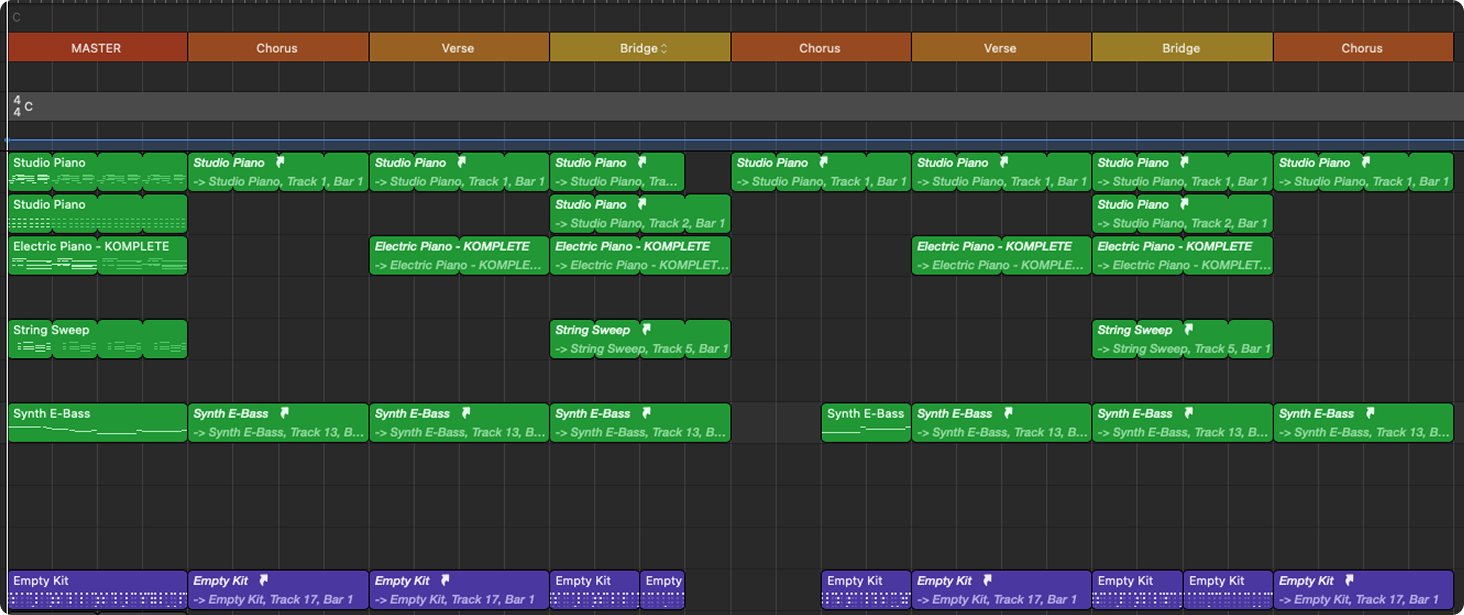
Once the arrangement is down, I play it back and ask one question:
Does the beat take me from home to a destination and back home again?
That’s the feeling I’m after. If it’s there, the structure worked.
Here’s the part that actually saves the time, and it’s lifted straight from how components behave in Figma. When I copy elements of the master into a section in Logic, those elements are aliased (they stay linked to the master). So if I change the timbre of a string patch in the master component, that change propagates to every section where I used it, automatically. I’m never updating the same idea in four different places. I make the decision once, and the system carries it through the whole song.
That’s the whole trick. By basing every section on one master, I took the beatmaker’s process that feels famously abstract and gave it a structure rigid enough to finish inside. No more burning an afternoon polishing a single eight bars while the rest of the song stays empty.
The numbers bear it out. Across 2024 and 2025, I released five or six beats on streaming platforms and BeatStars. Halfway through 2026, I’ve nearly 6x’d that rate of completion. Not by spending more hours per beat, but by spending them better.
This is the part worth sitting with, and it’s why I’m a systems person in the first place:
Structure doesn’t kill creativity, it’s what lets you reach the end of a creative thought.
The master component didn't make my beats less original. It just got me to finished, over and over, which is the only place you learn and get better as a producer.